Sifting through the Noise
Like so many other aspiring authors, I’m part of many Facebook writing groups–for better or worse.
With an opener like that, I’m sure you know where I’m going, but you’ll have to bear with me.
I rarely post, and I mostly just lurk, which is a little counterintuitive given the point of joining. Call it being in a community, without actually participating in it.
The only times I engage in the groups are to send congratulatory comments to those who finally take the plunge and publish their book, compliment excellent excerpts, and provide constructive feedback on book cover designs (because I used to work as a book designer). 95% of the time, I’m just in the bushes peering through people’s windows.
I’m really mostly there to get inspired by folks who are so fearless in sharing their work with the public.
But with any Facebook group, comments aren’t always so nice or constructive. And while I’ve had experience working in the publishing industry and I am used to critique workshops since college, I still get anxious about how my target readers perceive my work.
I’ve also learned that asking for feedback from Facebook writing groups requires some filtering and sifting. It is still Facebook, after all.
In those groups, there are those who do provide actual constructive criticism and helpful feedback, and then there are those who just want to say whatever’s on their mind. It’s a reminder to treat these little online universes as the Wild Wild West.
Take, for example, last week, I created a mock-up book cover for my manuscript just for fun. My idea was about what if I went the self-publishing route and designed my own book cover?
Your first response might be, “Wait! Why don’t you hire an artist?”
Well, it’s because I already am! You’ve made it through this blog post, so I’m sure you’ve explored my website. I’ve also had years of experience designing books in the educational publishing space. But if I do need a design that’s well beyond my skillset, trust me: I’ll hire someone better than me.
But again, this exercise is purely for fun, creative pursuits! In my brain, the mock-up is the mock-up, not the final product.
Anyway, my inspiration for the mock-up is the book cover for Logic’s novel, Ultra 85. I love how minimalist and beautiful it looks.
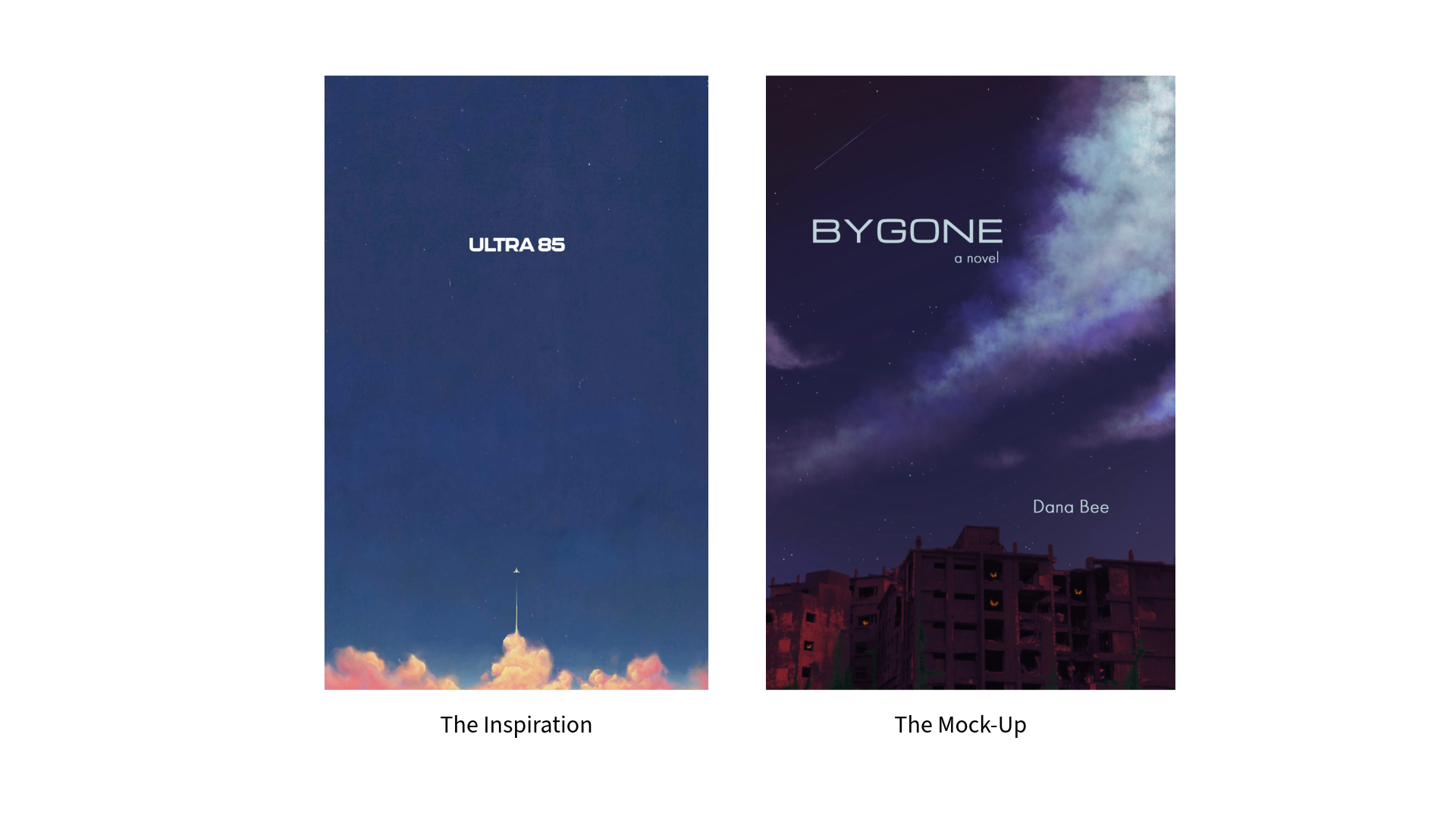
A side-by-side comparison of my inspiration vs my mock-up. My design in nothing compared to Sam Spratt’s!
I shared my mock-up with a Facebook writing group I’m in because most of the target audience is from there.
In the caption, I listed the genre as sci-fi post-apocalyptic romance. My question was, “If you saw this book cover, would you stop and look at the blurb?”
I got a variety of constructive feedback and fair assessments (“I like your font choice.” “I’m not your audience, but it made me stop and look!” “Make your typography larger. Be proud that you wrote this book.” “I don’t see romance on this book cover, sorry.” “The buildings on the front look like villas.” “Remove ‘a novel’. It looks amateurish.” “It makes me think of post-apocalyptic sci-fi!” “Consider how this will look as a thumbnail.” “I like it!”etc.) and then there were others who simply said they’d just keep scrolling if they saw my book cover, which is also valid feedback.
The great thing about feedback is that it lets you see what you don’t see. I responded to everyone, thanking them for their thoughts. I accept them and don’t make excuses, at least not in the comments section.
I also received two standout negative pieces of feedback: “It looks unprofessional, and so I would assume that the writing is also unprofessional,” and “This book cover looks homemade.”
For the first one, I responded with, “Thank you for your feedback. I’m curious to know what makes it look unprofessional, just so I can improve it.” I never got a response. It’s always good to ask, though.
For the second one, I didn’t choose to respond because of two things:
She’s right. It is homemade. Haha! I made it myself–with the skills I have working as an in-house book designer! It’s also a mock-up, not a final product. (<— Now, this is me making an excuse.)
I looked into her body of work to compare her book covers to the level of book cover professionalism she expects others to have. After looking through her page, I'd say I would agree to disagree with her feedback based on her own book covers.
This is where we sift through the noise.
Feedback is excellent. I love getting feedback.
Some of them build me up and boost my confidence. Some of them are hard to hear, but they’re also good for my growth.
Give it to me honestly, and don’t sugarcoat it. If it’s harsh, I need to know the why behind it, so I can improve. I’ve heard worse things. I’ve worked for a megalomaniac before, and I play video games a lot. Trust me, I can take it.
Feedback is the great and exciting part of editing (which I need to start doing soon).
I also want to know how my target audience thinks because, at the end of the day, I’m selling my story to them.
Just recognize that some feedback is simply noise. All you need to do is identify them and ignore them.
While you receive feedback, you also need to trust your own knowledge of what you’re creating. Determine the helpful comments and apply them to your work. Ignore the rest as noise.
The exercise was a great way for me to know how people would perceive a book cover like that. But even after that, I still get pretty anxious about sharing my work with people. Will they like it? Will they hate it? I don’t know!
But putting out a book is never like working in a vacuum. Feedback and considering outside opinions on your work are part of the work. It also doesn’t necessarily mean you need to take everyone’s advice.
The reality is that some people will keep scrolling past your book, while others will pick it up and give it a try.