Blue Blooded
When I was a teen, I visited a great-aunt–my grandfather’s sister–at her nondescript manor in the heart of Davao City.
The manor, on the outside, was all concrete and overgrown. The ground, once paved in expensive ornamental slabs, was cracked and waged a losing battle with stubborn weeds. Twigs and leaves were strewn all over the yard, and skeletal bushes lined up the perimeter of the property. But once we entered the building–walked past unlit hallways that smelled like an antique store–we found ourselves inside a golden ballroom with marble floors and sunlights, decorated with gold-painted upholstery, tiny French ceramic figurines in crystal display cases, and Chinese vases as tall as I was.
I vividly remember my great aunt making an entrance in her expensive cashmere pantsuit, all dolled up and smiling. Too dolled up, as I noticed her blush was saturated pink. She was supposedly bedridden, but somehow, today, she had gotten her strength back. Another aunt whispers close by that my great aunt had been pumped up with uppers that helped her walk.
We gathered around their ornate long table for lunch as she slowly approached the head, all eyes on her. A piece of paper was passed on to her, which she held with bejeweled fingers. It was a certificate proving that my mother’s maiden name and our lineage are linked to a small, obscure duchy in Spain and that they trace back to the followers of Saint Stephen. The details are hazy, but I remember my great-aunt reading it with pride before one of her nephews pressed it in a mahogany frame.
The story told to my sisters, cousins, and I was that we were related to some duke in España. My mother’s aunts were highly regarded in Davao back then, always the talk of the town for their light skin and beauty. They joined pageants and dance shows that treated them like local celebrities. There were old newspaper headlines framed and saved as further proof.
For a long time, I listened intently to those stories. I was starry-eyed when that revelation was first told to me. As a kid, it made me feel important.
But of course, it didn’t really mean anything but self-importance.
It was the kind of self-importance that was skin deep and tinged with colonial mentality. There was an emphasis on a Eurocentric kind of beauty that could only be the physical proof of our family’s connection to any blue-blooded Spanish lord. Praise was given to the tall, straight-haired, skinny, and fair-skinned women in the family. The further you are from my grandmother’s brown skin, short stature, and wide nose, the better. Be as far removed from being indio as possible.
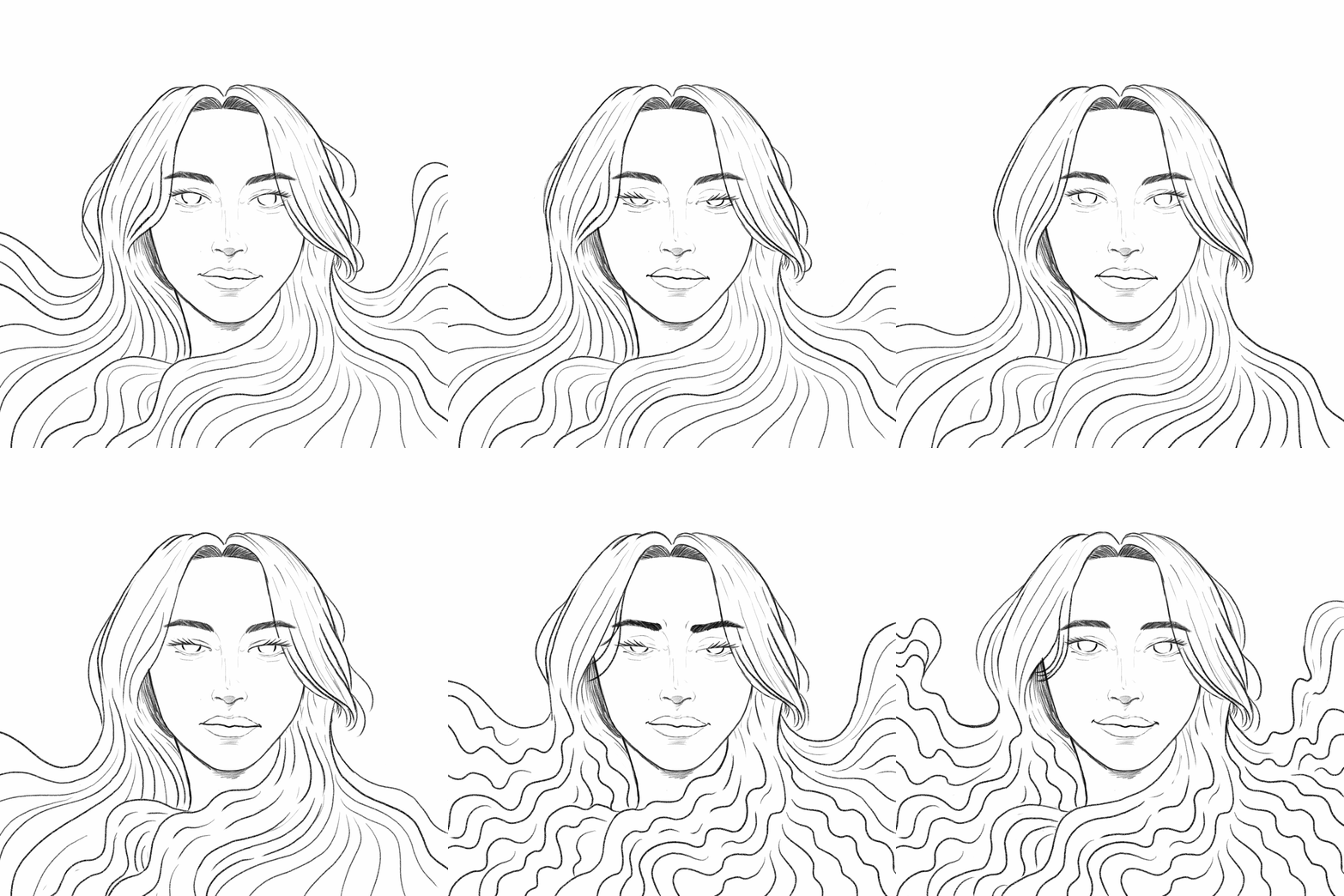
Made this .gif around how I feel about all of this
My height did not meet the requirement, as I was often reminded. At least, I could slather papaya soap all over my skin in hopes of making me look paler, and I was blessed with a bridge on my nose–all that pinching work my mom, my aunts, and my nannies did to my nose as a child paid off, I guess. As for my wavy hair, nothing like a monthly trip to the salon and sitting for 6 hours straight while chemicals were poured on my scalp could fix.
Funnily enough, the uncles and sons and nephews were spared from this.
Another piece of evidence of our royal relation was the stories of how my grandfather and great-aunts enjoyed an abundant lifestyle. They grew up in another manor and attended society parties. My grandfather had a slew of women crying behind him, while my great-aunts entertained rich and handsome suitors lined up at their doorstep.
My mom’s older sister and older female cousins lived this kind of lifestyle as well. But by the time my mom reached girlhood, the riches had long gone. You see, my mom remembers growing up poor. The manor was the last remnant, which my great-aunt was the sole heiress of. At some point, the wealth dissipated–as if by magic. Whispers of gambling and mistresses were thrown around, but we weren’t focusing on that. We were blue bloods!
“Look at this picture of your great aunt performing a dance for the governor! She was the belle of the ball!”
The self-importance was also expressed through authority over other family members, especially those who were economically struggling or younger. The older folks did not withhold opinions, whether it was about your body, your money, your politics, or your autonomy. They could say whatever they wanted–especially if they disagreed with you.
You also can’t be too smart. Beauty outweighed intelligence. School is great, but if you study too much, then you’re weird.
I studied a lot. I guess I had to make up for my height or something. Draw your conclusions about where I am on the totem pole based on the two former sentences. But I realized that the more I learned about the world, the more plot holes I found around this story. Maybe this is why you can’t be too smart. You see through things and then you ask too many questions.
Either way, there is no use expending energy on debunking the story. It’s just another harmless family story that you tell whenever you have a family reunion, anyway. But that doesn’t stop me from analyzing how deeply ingrained colonial mentality is within our family and how it becomes an avenue for toxic interactions.
I don’t so often bring up this story about my family. But every time I remember it, my perception around it always changes, especially as I grow older. As a kid, it was kind of magical. At one point, I was angry. Nowadays, there’s clarity.
I couldn’t blame them. As an adult, it was kind of sad.
I know my family is deeply flawed, just like I am. They were raised around this story and to believe in this kind of self-importance, to hold onto a relic of the past that reminded them that they were once highly regarded before all the wealth–and the respect and reverence that went with it–was depleted. They didn’t know how to deal with that loss. They were not equipped. Of course, there’s no excuse for the toxic behavior that came with the self-importance. But now I understand where they’re coming from.
It’s safe to say that my sisters, cousins, and I don’t put much weight on the story, and, in turn, don’t have the level of unhealthy self-importance that comes with it. We’ve accepted our browner skin, our wavy hair–and for me, my lack of verticality. We speak to each other in the most honest yet respectful of ways, and we’ve established our boundaries.
Looking back, I’m not even sure if these stories were true. Maybe it is, but who knows? The manor has long been sold, and it’s a mystery if any of my great-aunt’s direct family kept any of the framed evidence. She revered those pieces of paper so much, painstakingly protecting them in glass and painted wood, only for them to disappear. I’m curious if any of them were kept. I ought to ask some distant cousins about them.
My great aunt passed away a few weeks later after that gathering. My mom and my aunts still bring up the story of our supposed royal relation whenever we see each other. But I don’t believe that story has continued down to third cousins, nephews, and nieces. Maybe writing it here is my way of passing it along, while also recognizing that it’s all just a story, not an entire identity.